
What managers and providers should have on the radar
The live sector theme is sufficiency with evidence behind it. The issue is not simply whether more beds exist somewhere in the system. The practical question is whether registered, suitable homes are available for the children who need them, with the right staff, location, oversight and daily risk visibility.
That matters for a care recording platform because daily notes, handover, staffing pressure, incidents, missing episodes, medication records and manager review are increasingly part of the same assurance picture. Separate records make sense only until somebody has to evidence what actually happened.
1. Unregistered provision is now a headline regulatory issue
Ofsted has announced a sharper approach to unregistered children's homes, linking the issue to unsafe and unlawful placements and wider sufficiency pressure. Its accompanying sector statement says Ofsted was made aware of over 900 unregistered children's homes in 2024 and highlights concerns about criminal exploitation, unvetted adults and high-cost placements.
Operational read-across: providers need to be ready to show registration status, placement suitability, safe staffing, safeguarding action, manager review and local authority communication without hunting through disconnected records.
2. Sufficiency is being framed as suitability, not just numbers
New DfE sufficiency material says provision can look sufficient on paper while still not being genuinely available or suitable for individual children. It also links sufficiency to workforce availability and qualifications.
Operational read-across: a home does not evidence safe capacity by counting empty rooms. It needs to show matching, staffing, risk profile, training, rota resilience and whether a place can genuinely meet a child's needs.
3. The children's social care reset is moving into implementation
The DfE implementation plan for England focuses on earlier help, stronger family networks and stable, registered, high-quality placements for children in care. Government reform updates also place workforce support, professional standards for children's homes staff, streamlined Ofsted registration and agency worker regulation from 2028 in the same reform lane.
Operational read-across: homes will be expected to show how daily practice connects to care planning, workforce decisions, management oversight and quality assurance, not just that a record exists somewhere.
4. Secure homes capacity remains sensitive
The latest secure children's homes statistics reported 14 secure children's homes in England and Wales, 218 approved places, 195 available places, 139 children accommodated on 31 March 2026 and an occupancy rate of 64%. The release warns that lower occupancy does not automatically mean suitable availability because placements depend on contract status, individual need and staffing/resource assessment.
Operational read-across: the wider residential system cannot talk sensibly about capacity without talking about suitability, risk, placement purpose, staffing and evidence.
5. Market scrutiny and ownership questions continue
Parliament, Ofsted ownership data, NAO analysis and independent policy work all keep pointing to the same pressure points: high costs, uneven supply, private-sector dominance, provider resilience and local authority difficulty shaping the market. Recent national reporting has kept private equity and public-service risk in the public conversation as well.
Operational read-across: a provider's strongest answer is not glossy copy. It is calm, traceable evidence that the home is staffed, managed, responsive and able to evidence risk decisions from ordinary daily work.
How ResiNotes fits this direction
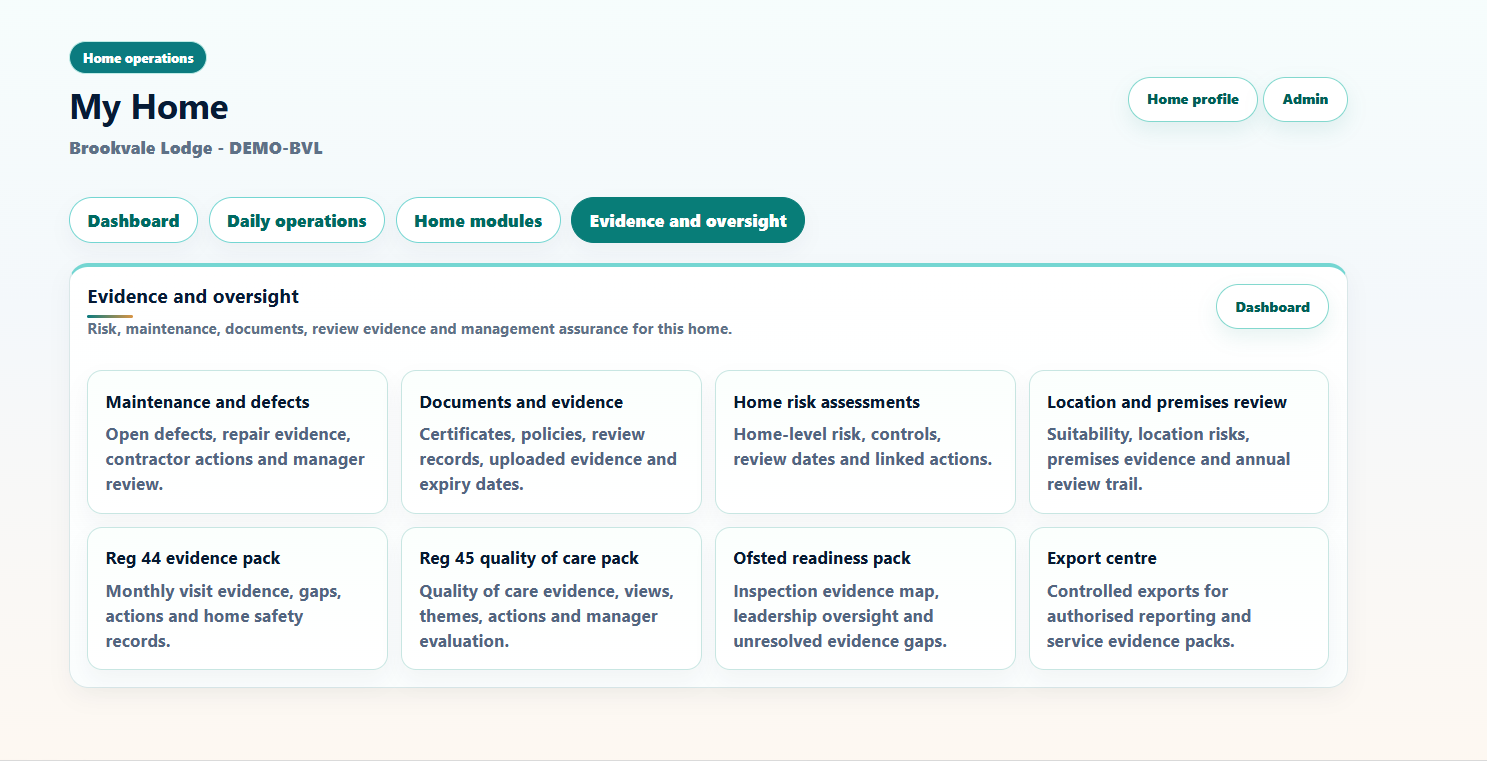
ResiNotes brings the daily operating picture together: daily records, handover, rota safety, incidents, missing episodes, protected triggers, medication/eMAR, visitors, home checks and management attention queues.
The public demo is deliberately simplified in places, but the direction is clear: evidence should be created as the home works, not assembled later during a separate review exercise.
Sources used for this roundup
- Ofsted - plans to tackle sharp growth in unregistered children's homes
- Ofsted - changing its approach to unregistered children's homes
- Department for Education - Delivering the children's social care reset
- Department for Education - children's social care reforms next steps
- Department for Education - understanding children's social care sufficiency in England
- Explore Education Statistics - children accommodated in secure children's homes 2026
- Public Accounts Committee - financial sustainability of children's care homes
- Institute for Government - fixing the children's social care market
- Ofsted statistics - ownership of children's social care providers in England 2025
- National Audit Office - Managing children's residential care